London Underground advertising is bought in two-week bursts, priced per panel, per station or per line pack, and planned around one thing the rest of the media landscape cannot offer: an audience with nothing else to look at. This guide covers the formats, what they cost, how to pick stations, and what happens between signing off a brief and going live.
Why the Underground works
A Tube journey is a rare gap in the day with no second screen. Phone signal is patchy, the escalator takes as long as it takes, and the platform wait is dead time. Advertising is what there is to read, and the audience is standing still while it reads.
The second thing that matters is repetition. A regular commuter passes the same sites on the way in and the way out, and does it again the next day, which is why the network can carry a considered purchase as well as a launch. A campaign that would need heavy weight elsewhere to register can work on frequency here.
The formats
There are fifteen buyable formats, split between digital screens, paper and vinyl, and whole-station packages. Digital costs more per site but buys day-parting, multiple executions and shorter lead times. Paper still buys scale for less, and it is the only way to buy some of the largest sites on the network.
| Format | Type | Creative size | Dwell | Indicative cost |
|---|---|---|---|---|
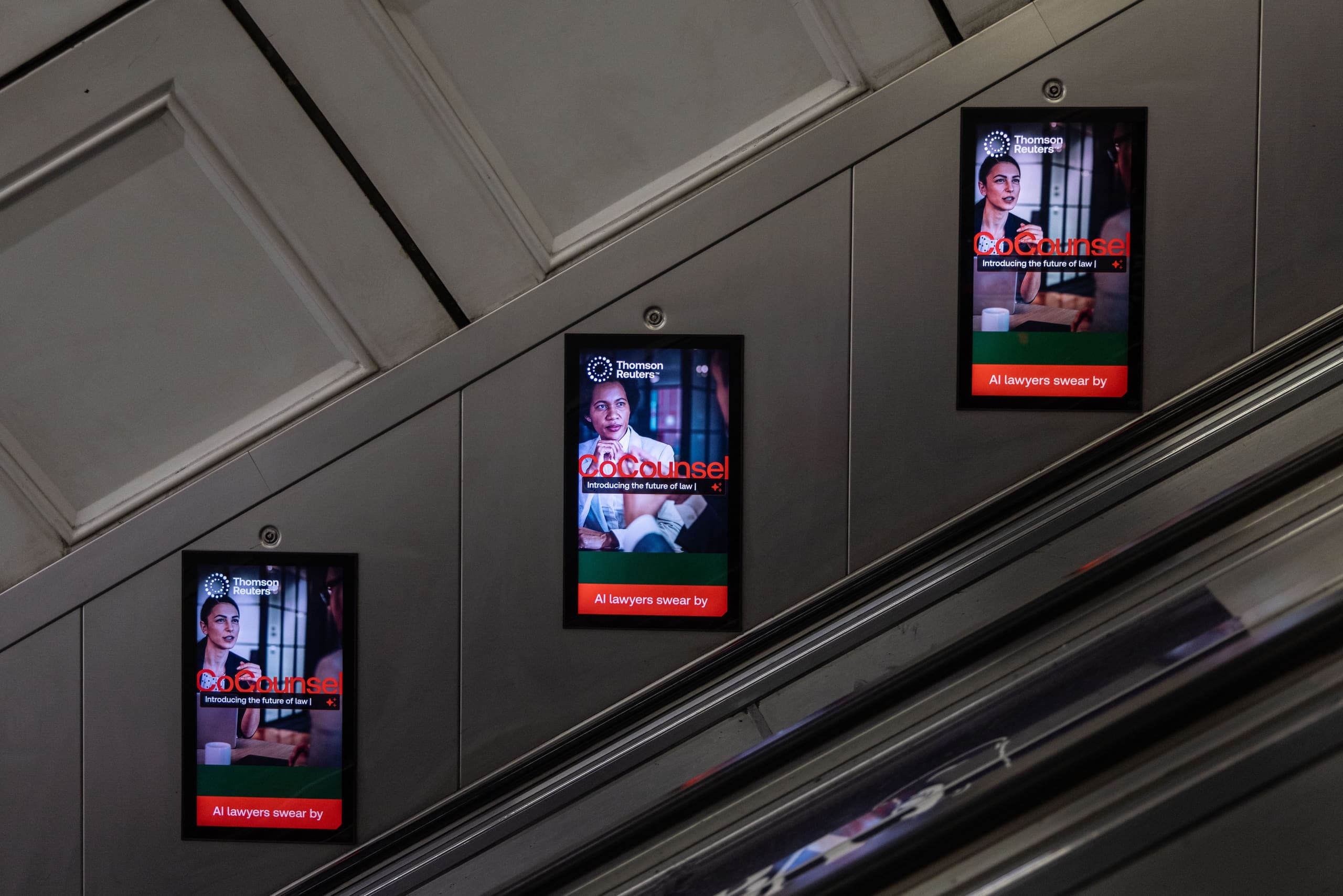
| Digital escalator panels | Typedigital | Creative size1920 x 1080 px (w × h), rotated for a portrait screen, 10 second slot | DwellThe length of the escalator ride | Indicative cost£25,000 per station run, per 2 weeks |
| Digital gateways | Typedigital | Creative sizeLandscape, resolution varies by station | DwellHead-on, as passengers enter the ticket hall | Indicative cost£12,000 to £40,000 per 2 weeks |
| Digital 6-sheet (D6) | Typedigital | Creative size1920 x 1080 px (w × h), rotated for a portrait screen, 5 second slot | DwellAt eye level, while passing through | Indicative cost£1,500 per screen, per 2 weeks |
| Digital 12-sheet (D12) | Typedigital | Creative size3840 x 2160 px (w × h), 10 second slot | DwellAt eye level, while passing through | Indicative cost£3,000 per screen, per 2 weeks |
| Digital 48-sheet (D48) | Typedigital | Creative size1920 x 1200 px (w × h), 10 second slot | DwellThe full platform wait | Indicative cost£2,000 per panel, per 2 weeks |
| Digital ribbon | Typedigital | Creative size1920 x 1080 px (w × h) per screen, 10 second slot | DwellThe length of the escalator ride | Indicative cost£35,000 per run, per 2 weeks |
| Tube car panels | Typestatic | Creative size609 x 280 mm (w × h) | DwellThe length of the journey, at reading distance | Indicative cost£18 per panel, per 2 weeks |
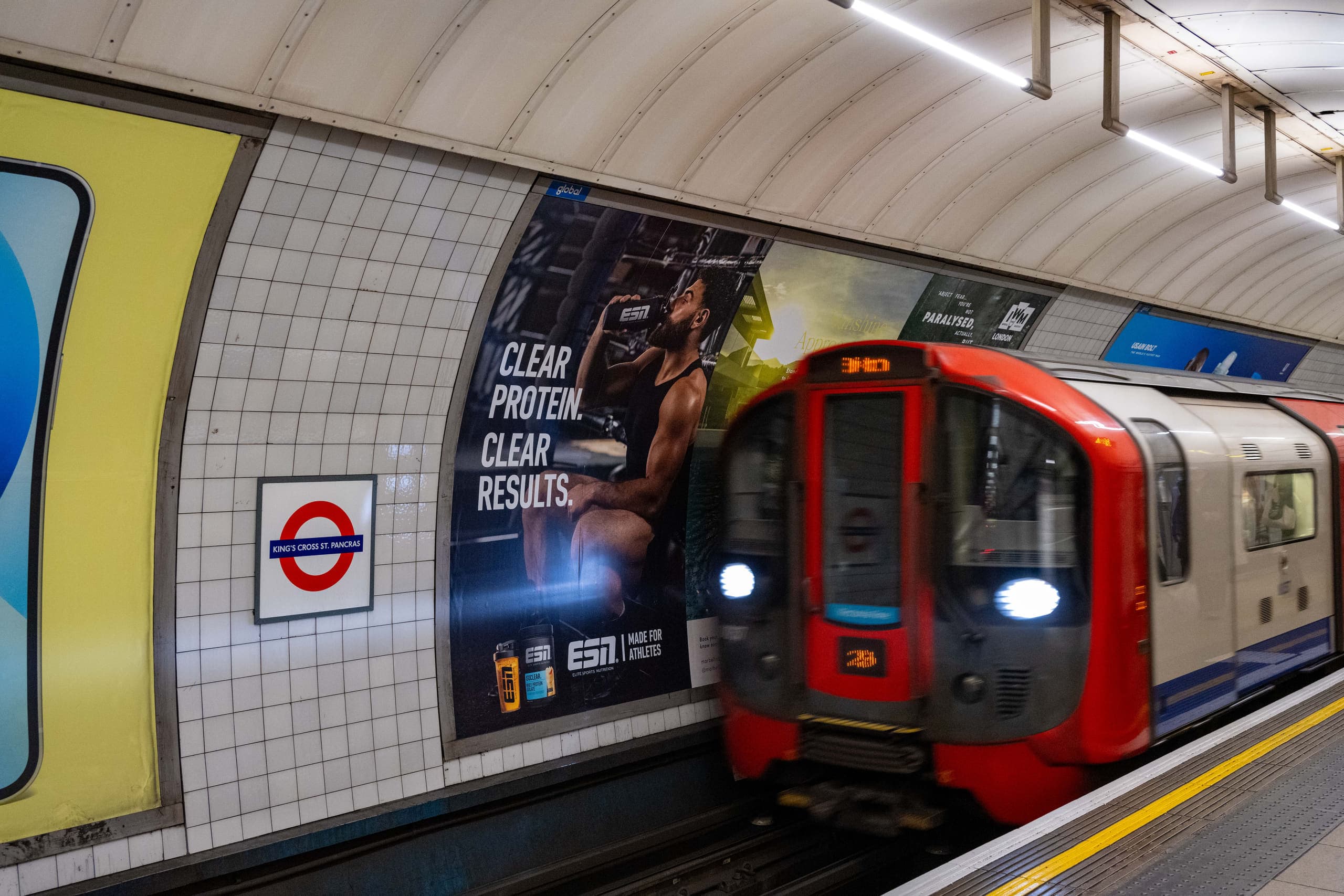
| 16-sheet cross-track | Typestatic | Creative size2032 x 3048 mm (w × h) | Dwell3 minutes average platform dwell | Indicative cost£2,250 per panel, per 2 weeks |
| 48-sheet posters | Typestatic | Creative size6060 x 3048 mm (w × h) | Dwell3 minutes average platform dwell | Indicative cost£6,000 per panel, per 2 weeks |
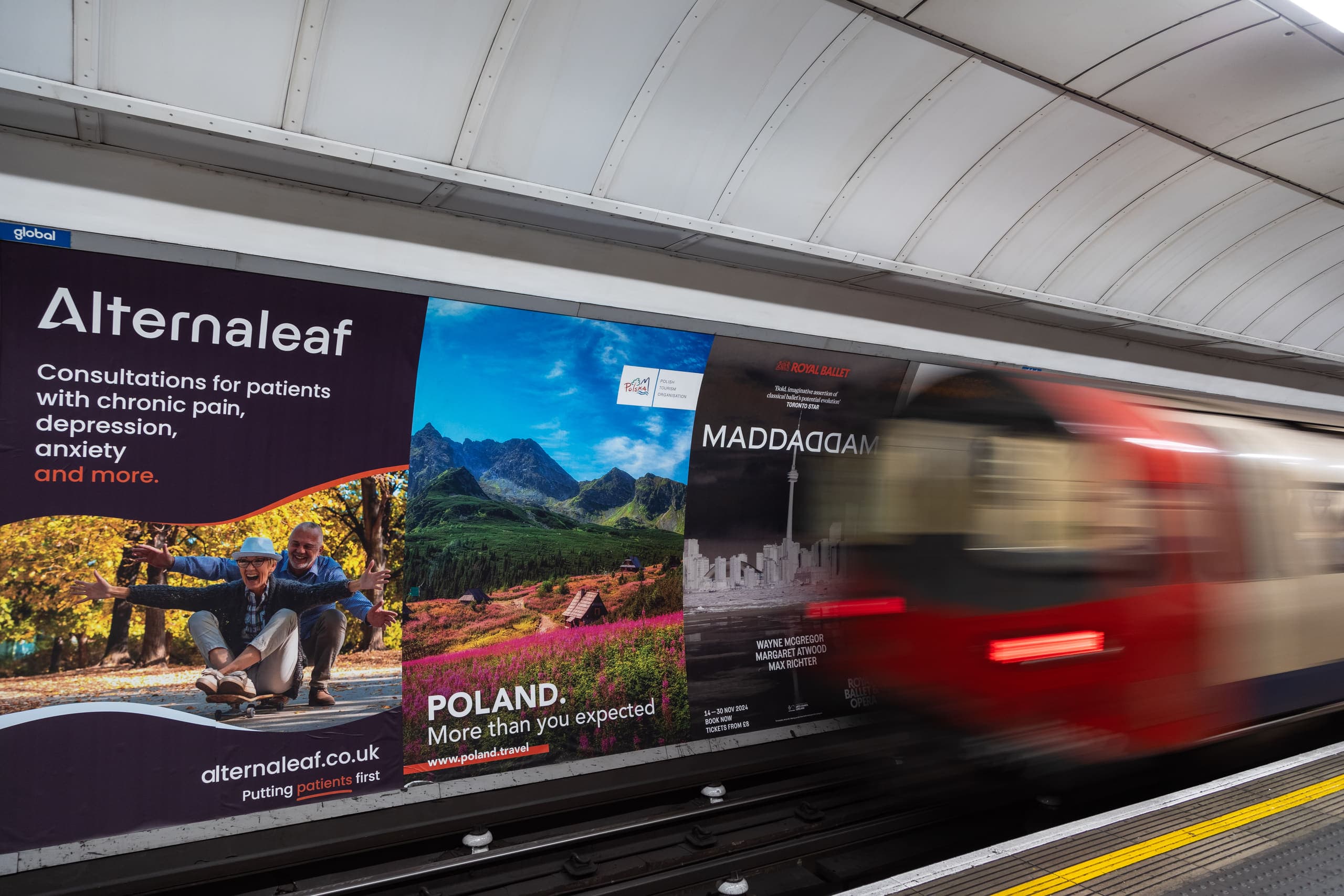
| 12-sheet posters | Typestatic | Creative size3048 x 1524 mm (w × h) | Dwell3 minutes average platform dwell | Indicative cost£2,000 per panel, per 2 weeks |
| 96-sheet posters | Typestatic | Creative size12192 x 3048 mm (w × h) | Dwell3 minutes average platform dwell | Indicative cost£1,800 to £3,200 per panel, per 2 weeks |
| 6-sheet posters (paper) | Typestatic | Creative size1200 x 1800 mm (w × h) | DwellAt eye level, while passing through | Indicative cost£1,750 per panel, per 2 weeks |
| 4-sheet posters | Typestatic | Creative size1016 x 1524 mm (w × h) | DwellAt eye level, in high-footfall positions | Indicative cost£750 per panel, per 2 weeks |
| Escalator panels (static) | Typestatic | Creative size419 x 572 mm (w × h) | DwellThe length of the escalator ride | Indicative cost£300 per panel, per 2 weeks |
| Station domination | Typepackage | Creative sizeBespoke pack | DwellThe whole journey through the station | Indicative cost£40,000 to £250,000 per station, per 2 weeks |
Every rate below is indicative planning guidance rather than a quote: it is what the format has been costing, not what is being held for you. The figure that matters is confirmed with the media owner once the stations and dates are fixed.
What it costs
Most campaigns land between £3,000 and £120,000 for a two-week burst. A poster campaign across a handful of stations starts around £3,000, print and production included. A full digital escalator run at one station is £25,000 a fortnight. A full station domination starts at £40,000. All of those exclude VAT.
| Format | Indicative cost | Buying unit |
|---|---|---|
| Digital escalator panels | Indicative cost£25,000 | Buying unitper station run, per 2 weeks |
| Digital gateways | Indicative cost£12,000 to £40,000 | Buying unitper 2 weeks |
| Digital 6-sheet (D6) | Indicative cost£1,500 | Buying unitper screen, per 2 weeks |
| Digital 12-sheet (D12) | Indicative cost£3,000 | Buying unitper screen, per 2 weeks |
| Digital 48-sheet (D48) | Indicative cost£2,000 | Buying unitper panel, per 2 weeks |
| Digital ribbon | Indicative cost£35,000 | Buying unitper run, per 2 weeks |
| Tube car panels | Indicative cost£18 | Buying unitper panel, per 2 weeks, minimum 550 panels |
| 16-sheet cross-track | Indicative cost£2,250 | Buying unitper panel, per 2 weeks |
| 48-sheet posters | Indicative cost£6,000 | Buying unitper panel, per 2 weeks |
| 12-sheet posters | Indicative cost£2,000 | Buying unitper panel, per 2 weeks |
| 96-sheet posters | Indicative cost£1,800 to £3,200 | Buying unitper panel, per 2 weeks |
| 6-sheet posters (paper) | Indicative cost£1,750 | Buying unitper panel, per 2 weeks |
| 4-sheet posters | Indicative cost£750 | Buying unitper panel, per 2 weeks, minimum 5 posters |
| Escalator panels (static) | Indicative cost£300 | Buying unitper panel, per 2 weeks, minimum 10 panels |
| Station domination | Indicative cost£40,000 to £250,000 | Buying unitper station, per 2 weeks |
Planning guidance, excluding VAT. Poster rates include print and production where stated. Confirmed with the media owner at booking.
Seven things account for most of the variation between one campaign and the next.
- Zone
- Zone 1 carries a premium over zones 3 and beyond for the same format, driven by footfall and audience profile.
- Trading period
- January and August are the softest months. The Christmas run-in and September carry the highest rates.
- Digital versus static
- Digital costs more per site but buys flexibility: day-parting, multiple executions and shorter lead times.
- Production
- Poster print and posting is a meaningful share of media cost. Digital artwork is usually a fixed studio fee.
- Duration
- Two weeks is the standard burst. Four and six week bookings usually attract a volume discount.
- Lead time
- Booking six to eight weeks out protects both price and site quality. Late bookings pay for what is left.
- Number of sites
- Posters and digital 6-sheets are priced per panel, escalator panels and dominations per station, car panels per line pack. How many you take is usually the single biggest lever on the total.
Choosing stations
Footfall is the starting point, not the answer. The highest-footfall stations are the most expensive and the most contested, and a large share of the people passing through them are not your audience. The right station is the one whose catchment, zone and dwell match what you are selling.
- Interchanges buy reach: a wide audience mix, high volume, high rates.
- Terminus stations buy dwell: people wait, so longer copy works.
- Destination stations buy intent: retail, venues and offices within a short walk.
- Outer-zone stations buy efficiency: lower rates against a residential catchment.
The station finder covers every advertising location across the Underground, the Elizabeth line and the DLR, filterable by network, zone and line. Where we hold inventory records for a station, its page lists the formats recorded there.
Creative and copy clearance
Artwork is supplied to the format's specification and goes through copy clearance before the on-air date. Clearance is not a formality: alcohol, gambling, financial promotions, health claims and anything aimed at children all attract closer scrutiny, and a rejection late in the schedule is expensive. Build clearance time into the plan rather than treating it as a final step.
- Confirm the specification for every site in the pack — they are not interchangeable.
- Supply artwork to the copy deadline, not the on-air date.
- Allow a round of amends after clearance feedback.
- For digital, supply each execution you intend to day-part.
Lead times and booking
Six to eight weeks ahead is the sweet spot for standard formats. It protects both the price and the quality of the sites you get, because late bookings buy whatever is left. Station dominations and peak trading periods need twelve weeks or more, and only one advertiser holds a station at a time — so the Christmas run-in goes early.
That is the schedule. The transaction underneath it — who holds the inventory, what gets checked before anyone commits, and how an indicative rate becomes a real quote — is a separate question worth understanding before making contact.
Measurement
Coverage and frequency come from the industry audience currency, alongside TfL station entry and exit counts. Larger campaigns can add brand lift or footfall studies. What outdoor measurement will not give you is a click: it tells you who had the opportunity to see the work and how often, not what they did next. Plan the evaluation before the campaign runs, not after.
Sources and references
- Transport for London — network and station data — Station counts, line data and fare zones.
- Media owner rate cards — Every price on this site is indicative planning guidance, confirmed with the media owner at booking.
- The out of home audience currency — Coverage and frequency measurement for the out of home sector.