Digital 6-sheet (D6) advertising
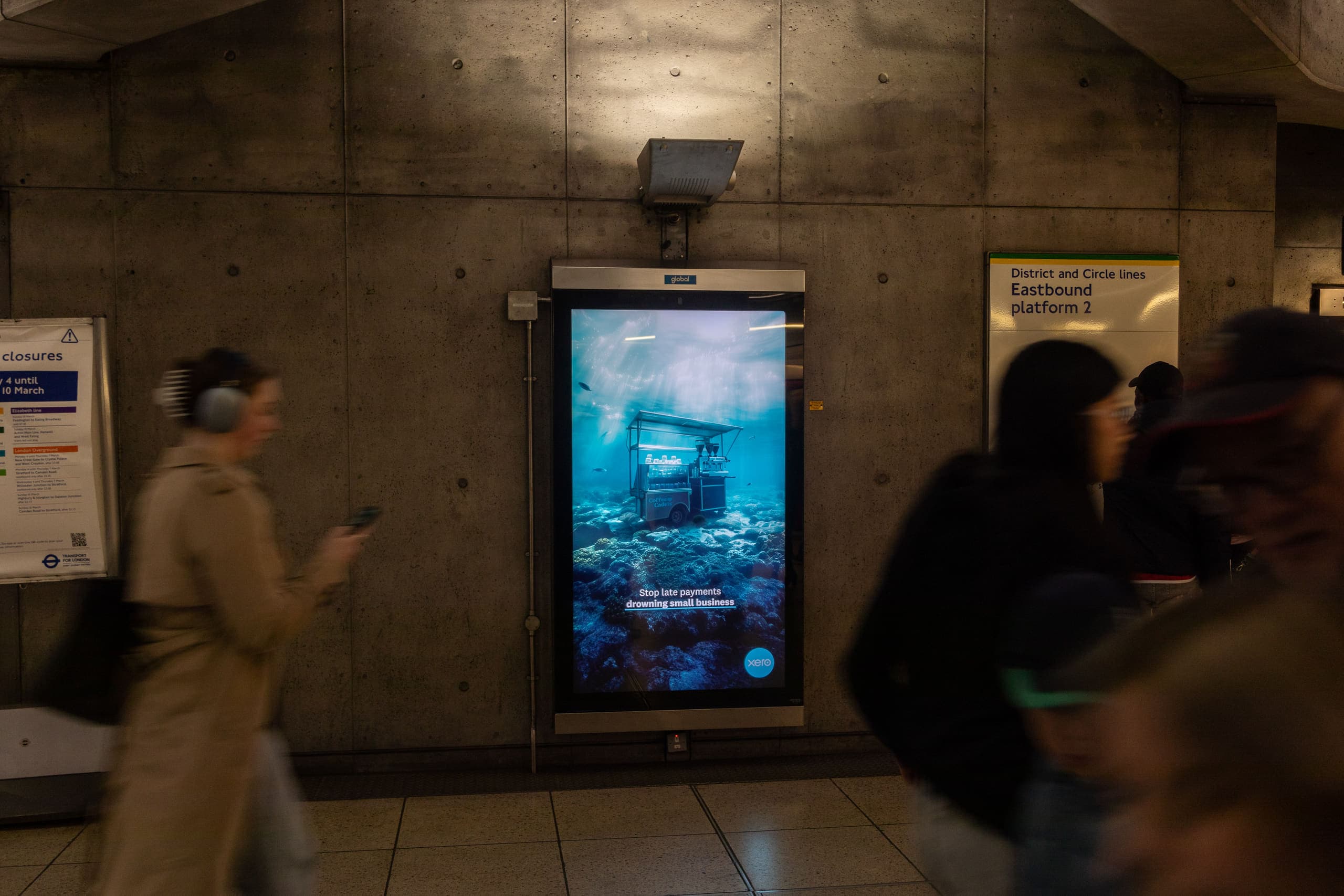
Portrait screens at eye level in ticket halls, entrances and concourses, carrying five seconds of full motion.
From £1,500 per screen, per 2 weeks
Specification
- Format type
- digital
- Creative size
- 1920 x 1080 px (w × h), rotated for a portrait screen, 5 second slot
- Typical duration
- 2 weeks
- Dwell time
- At eye level, while passing through
- Where it appears
- Ticket halls, entrances and concourses, network wide
- Best for
- Local awareness, Retail footfall
- Indicative cost
- £1,500 per screen, per 2 weeks
- Availability
- Network wide. Bought as a single station pack, a borough cluster or a network pack.
Example rate from our own campaign pricing, excluding VAT. Actual cost depends on station, dates, availability, volume and campaign requirements.
What it is
A Digital 6-sheet — D6 in a media schedule — is a portrait screen at roughly eye level, occupying the position a printed 6-sheet poster would. The artwork is supplied as a 1920 by 1080 file rotated onto its side for the portrait screen, and runs as a five-second slot in a rotating loop, so it carries motion where the paper equivalent cannot.
The screens sit in ticket halls, entrances and concourses, and are bought by the screen rather than as a fixed pack: a single station, a cluster of stations across a borough, or a network buy. That makes it one of the more granular ways to put a campaign in a specific part of London.
Why advertisers use it
The position is the point. A D6 stands where people are walking at their own pace and deciding where to go next — through a ticket hall, past an entrance, across a concourse — rather than where they are held waiting. That suits a message tied to somewhere nearby, which is why the format is bought for local awareness and retail footfall more than for national brand work.
Being digital, the slot also takes more than one execution in a single booking, and artwork can be supplied on a shorter lead time than anything printed. A campaign can run different messages in the same position across a flight without producing and posting a new poster for each one.
Cost
£1,500 per screen, per 2 weeks. Rates move with zone, station footfall and trading period: January and August are the softest, the Christmas run-in the hardest. Artwork is not in that figure. A D6 needs a produced digital execution rather than a printed sheet, and that studio cost is quoted separately at planning — which is the main thing to hold in mind when weighing it against a paper rate that includes print.
Whether that flexibility earns its cost depends on the campaign: digital and paper compared honestly.
Booking and lead time
Six to eight weeks ahead is the sweet spot: it protects both the price and the quality of the sites you get. Station dominations and peak trading periods need longer. Copy clearance sits ahead of the on-air date, so leave room for it in the schedule.
Designing for a portrait screen
The frame is tall and narrow and the reader is walking, so the composition wants to stack rather than spread: a single image or product occupying the upper two thirds, the line beneath it, the brand at the foot. Anything laid out to be read across the frame is fighting the shape.
Five seconds is the constraint everything else follows from. It is long enough for a short piece of motion to resolve — a reveal, a product turning, a line completing — and too short for a narrative with a setup. The executions that hold up treat the motion as one movement rather than as a compressed film.
If the booking carries several executions, they are more useful as a family than as unrelated advertisements. Someone passing the same screen twice a day for a fortnight sees the variations as one campaign if they share a structure, and as clutter if they do not. This is editorial advice rather than a specification: the mandatory requirements are the pixel dimensions and the slot length above, and copy clearance before the on-air date.
Supplying to spec is only half of it: copy clearance sits ahead of the on-air date.
D6 or a paper 6-sheet?
They occupy the same kind of position at a similar eye level, and the honest answer is that the choice turns on production rather than on media. The paper rate on this site is the higher of the two per site and includes print and posting; the digital rate is lower and does not include artwork. Which works out cheaper depends on a studio cost we quote at planning rather than on the rates alone.
Beyond cost, the split is straightforward. Paper buys one execution, held for the flight, and reaches the outer zones more easily. Digital buys motion, more than one execution, and a shorter lead time. If the campaign has one message and a long run, paper does that job without paying for flexibility it will not use.
D6 or D12?
The two are the same idea at different scales and opposite orientations. A D6 is a portrait screen taking a 1920 by 1080 file supplied rotated; a D12 is a much larger landscape screen at Ultra HD, 3840 by 2160. A landscape frame suits a scene, a group of products or a line that wants to run horizontally; a portrait frame suits a single subject standing in it.
Price and coverage separate them further. A D12 screen is twice the price of a D6 for the same fortnight, and the D12 estate is described as zones 1 to 3 where D6 is available network wide. So D6 is the format that reaches an outer-zone high street; D12 concentrates a larger frame in central London.
Stations to consider
Our inventory records show digital 6-sheet (d6) at these stations. Individual sites and availability are confirmed with the media owner when we plan the campaign.
- Zone 1 · King's Cross
King's Cross St Pancras
6 lines
70.3m entries and exits (2023)
- Zone 1 · West End
Oxford Circus
3 lines
66.9m entries and exits (2023)
- Zone 1 · South Bank
Waterloo
4 lines
65.9m entries and exits (2023)
- Zone 1 · Victoria
Victoria
3 lines
63.4m entries and exits (2023)
- Zone 1 · City of London
Liverpool Street
5 lines
61.9m entries and exits (2023)
- Zone 1 · London Bridge
London Bridge
2 lines
50.2m entries and exits (2023)
Campaigns using digital 6-sheet (d6)
Xero Software · Brand awarenessXero takes the late payments argument to Westminster
Digital 6-sheets on the Westminster platforms, aimed at the people who legislate on late payment as much as at the commuters beside them.
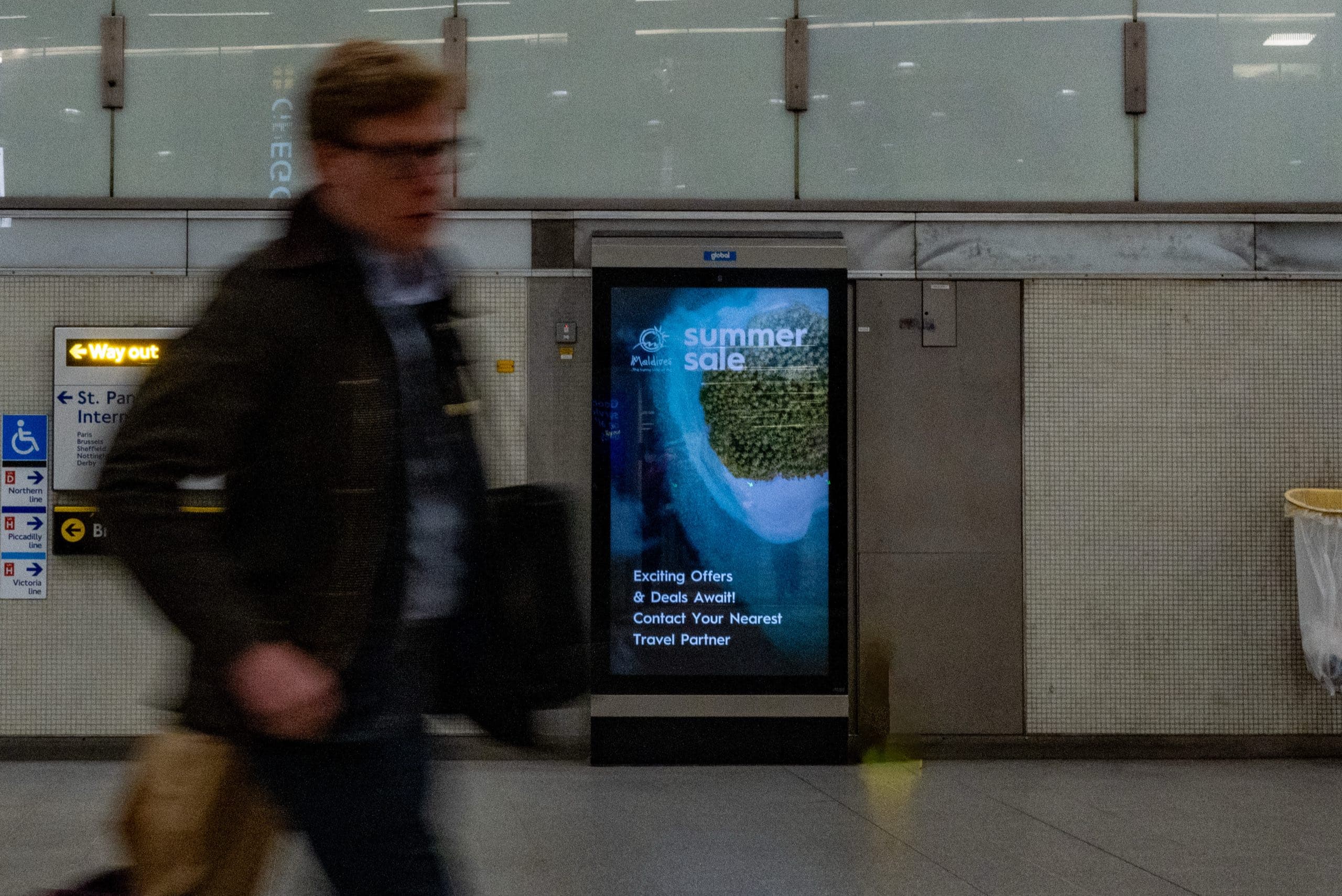
Visit Maldives Travel and tourism · Destination awarenessVisit Maldives runs a summer sale across three stations
Destination creative running as portrait digital in a mainline interchange and as framed posters in the circulation space at two more stations.
Related formats
- digital
Digital 12-sheet (D12)
The larger landscape screen in ticket halls and concourses, where a D6 is not enough presence.
From £3,000 per screen, per 2 weeks
- static
6-sheet posters (paper)
The larger static poster unit, at eye level in ticket halls and passageways where footfall is heaviest.
From £1,750 per panel, per 2 weeks
- digital
Digital escalator panels
Sequential screens running the length of the escalator shaft, synchronised so one story plays out as the passenger descends.
From £25,000 per station run, per 2 weeks
Digital 6-sheet (D6) questions.
£1,500 per screen, per 2 weeks. That is indicative planning guidance excluding production and VAT, and it moves with zone, station and trading period.
2 weeks is the standard booking, running Monday to Sunday. Longer flights are available and usually attract a volume discount.
1920 x 1080 px, rotated for a portrait screen, 5 second slot. Artwork goes through copy clearance before the on-air date, so allow time in the schedule for it.
Ticket halls, entrances and concourses, network wide. Network wide. Bought as a single station pack, a borough cluster or a network pack.
Get digital 6-sheet (d6) costs.
Send the brief and we come back with a site list, costs and on-air dates within two working days.
Get campaign costs